


Marlaya S.A. de C.V., a shell company linked to the huachicol fuel-smuggling network uncovered one year ago in Tampico, defrauded Mexico’s treasury of more than 29 billion pesos. That sum is equivalent to the cost of building 42 IMSS general hospitals or 134 local medicine clinics.
This single company caused fiscal damage twice as large as the Segalmex case during President Andrés Manuel López Obrador’s administration and four times larger than La Estafa Maestra under President Enrique Pena Nieto.
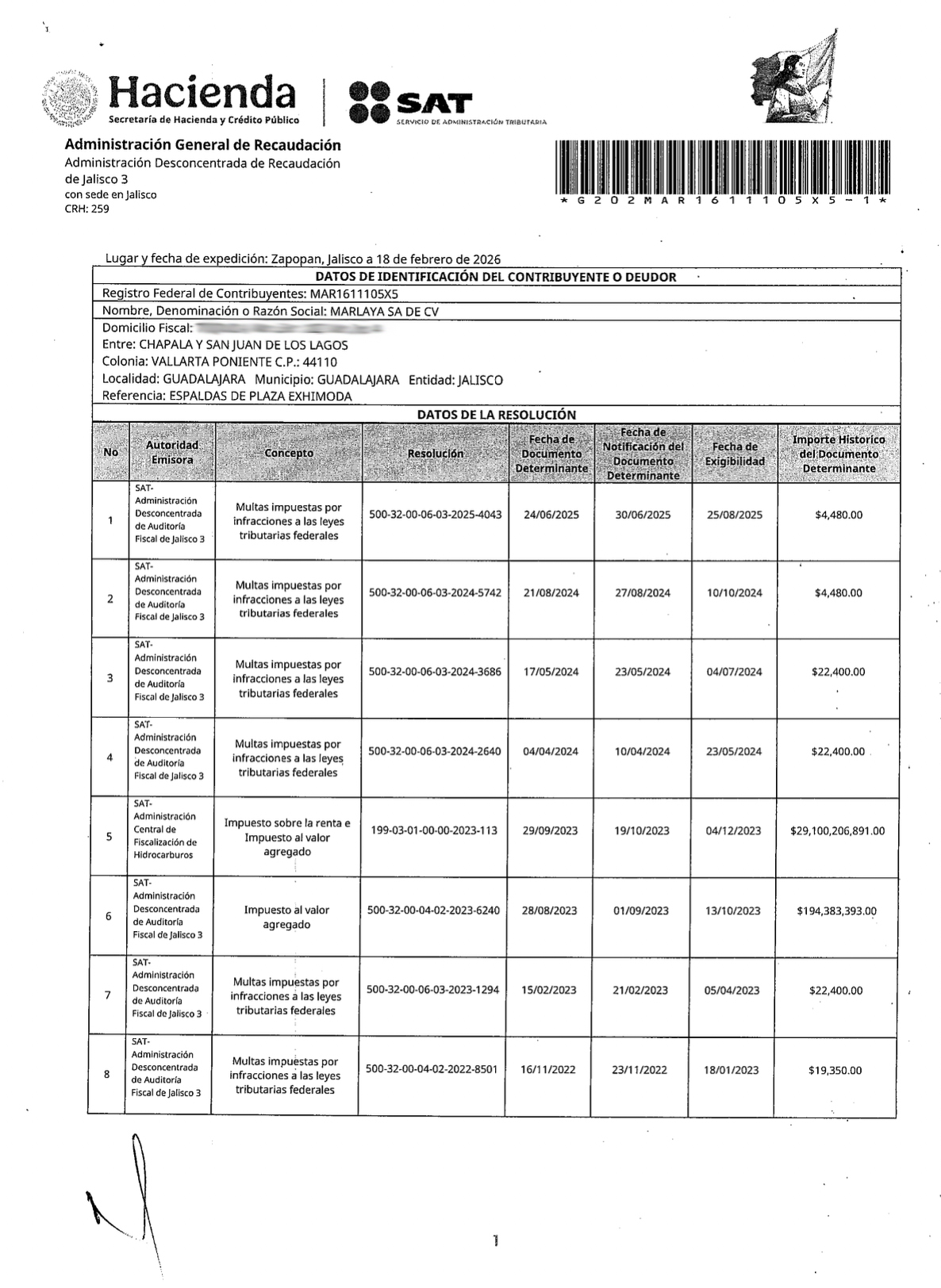
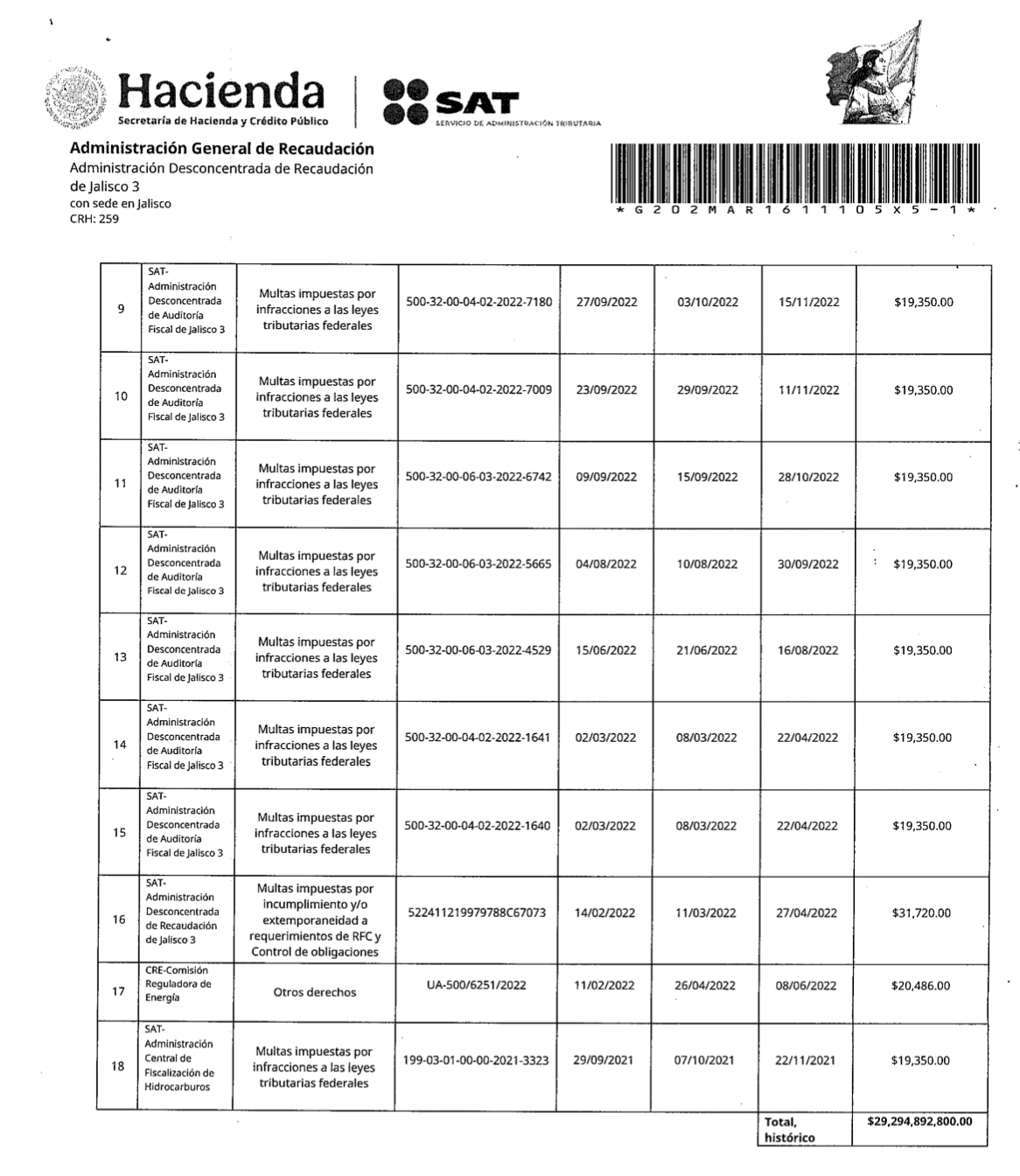
The resolution determining the amount of the loss was issued on February 18, 2026, by Tax Collection Administration No. 3, a Jalisco-based office of Mexico’s Tax Administration Service (Servicio de Administración Tributaria, or SAT), the tax-collection agency under the Finance Ministry.
The company was incorporated in Guadalajara in November 2016 with a corporate purpose so broad that it could be used to invoice the sale of virtually any type of service or product.
| What Could Be Paid for With the Tax Fraud of This Fuel-Smuggling Company? | |
| Description | Quantity |
| Cablebús or Mexicable lines | 9 |
| National high school campuses for 1,200 students | 501 |
| National Guard barracks | 862 |
| Leased Mexico City police patrol cars | 13,744 |
| National Guard pickup trucks | 22,977 |
| Family Medicine Units | 134 |
| General Zone Hospitals, 100-200 beds | 42 |
| Luxury pickup trucks for Supreme Court justices | 17,232 |
| Renovations of Chapultepec Forest’s Fourth Section | 3 |
| National Film Archive buildings | 45 |
| Police and traffic officers, based on average annual salary | 366,450 |
| Annual budget of the Anti-Corruption and Good Governance Ministry | 33 |
| Annual budget of the Interior Ministry | 3 |
| Annual budget of the National Electoral Institute | 1.3 |
| Annual budget of the National Human Rights Commission | 1.6 |
| Annual budget of the Federal Attorney General’s Office | 1.4 |
| Note: Cablebús and Mexicable are cable-car public transit systems in the Mexico City metropolitan area. IMSS refers to the Mexican Social Security Institute. SCJN refers to Mexico’s Supreme Court. INE is the National Electoral Institute. CNDH is the National Human Rights Commission. SHCP is the Finance Ministry. | |
| Source: MCCI analysis based on data from Mexico’s Finance Ministry, the Mexican Social Security Institute and the Presidency of the Republic. | |
Link to the huachicol fuel-smuggling network
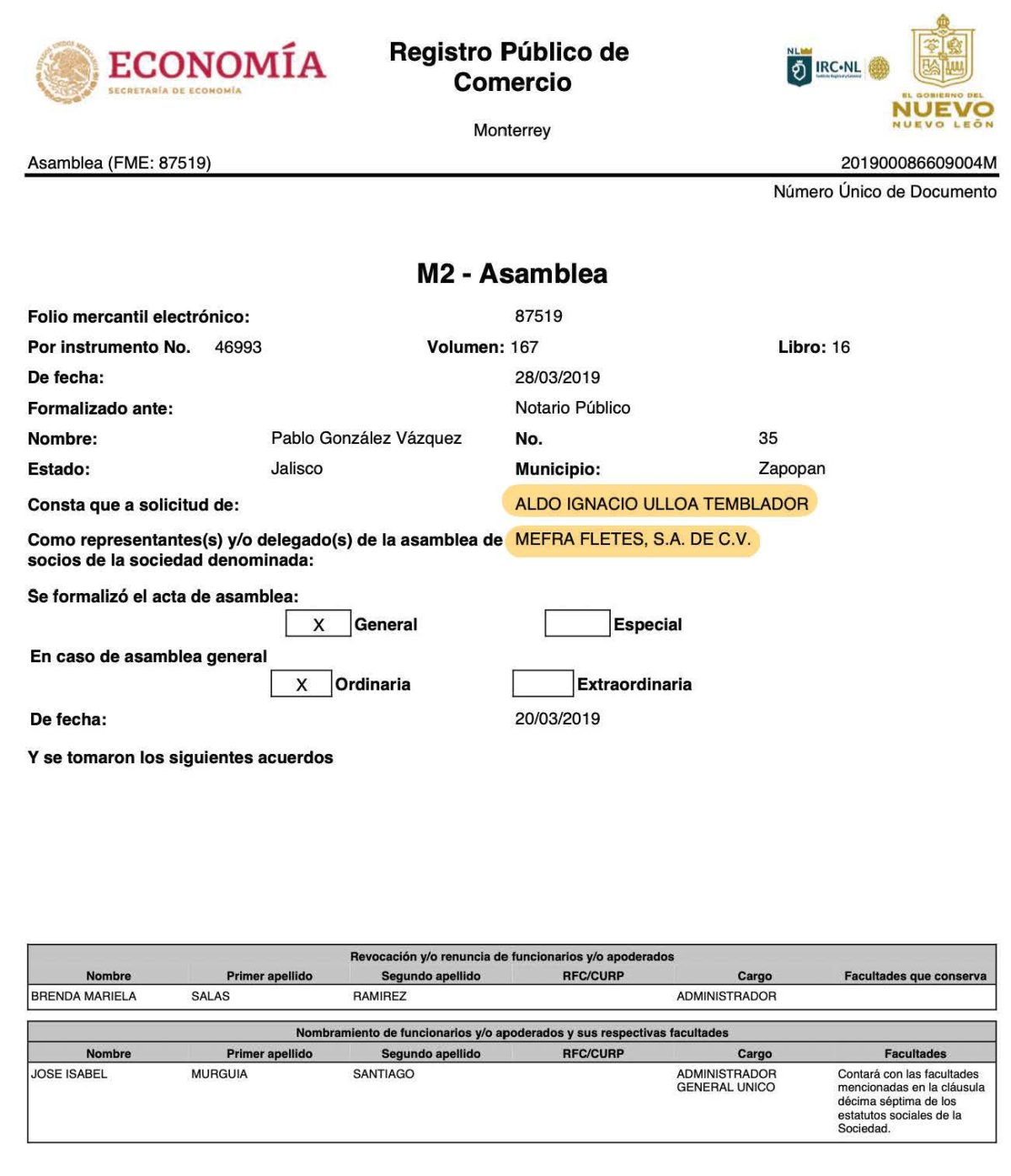
It was not until a May 2018 shareholders’ meeting that Marlaya expanded its activities to include the sale of petroleum products. Commercial records show that Aldo Ignacio Ulloa Temblador acted as delegate at that meeting. Ulloa Temblador has also served as representative of Mefra Fletes, a company involved in two massive seizures of 18 million liters of smuggled fuel carried out in late March 2025 in Tampico, Tamaulipas, and Ensenada, Baja California.
In fact, Ulloa Temblador represented Mefra Fletes at the March 20, 2019 shareholders’ meeting in which José Isabel Murguía Santiago was appointed sole administrator. Murguía Santiago is the brother of the former mayor of Teuchitlán, who is imprisoned for his alleged complicity in the crimes committed at the Izaguirre ranch.

On May 20, 2025, during his appearance at the president’s daily morning press conference, then-Attorney General Alejandro Gertz stated that Mefra Fletes and the Murguia Santiago brothers were linked to the Jalisco cartel.
«The former mayor of Teuchitlán, who has already been charged and is in prison, his two brothers and his family own all the trucks that were used, both in Tamaulipas and in Ensenada, to move that smuggled fuel, and all of this is ultimately linked to the Jalisco New Generation Cartel.»
Ulloa Temblador has also served as legal representative of Dalcrise S.A. de C.V., a company with an equity stake in Impulsora de Productos Sustentables, or IPS, another firm accused of fuel-tax fraud. IPS appears in the Atlantic Bay tanker case, in which Mexico’s Federal Attorney General’s Office (Fiscalía General de la República, or FGR) alleged that 21.5 million liters of diesel were smuggled through the port of Tuxpan, Veracruz, in October 2019.


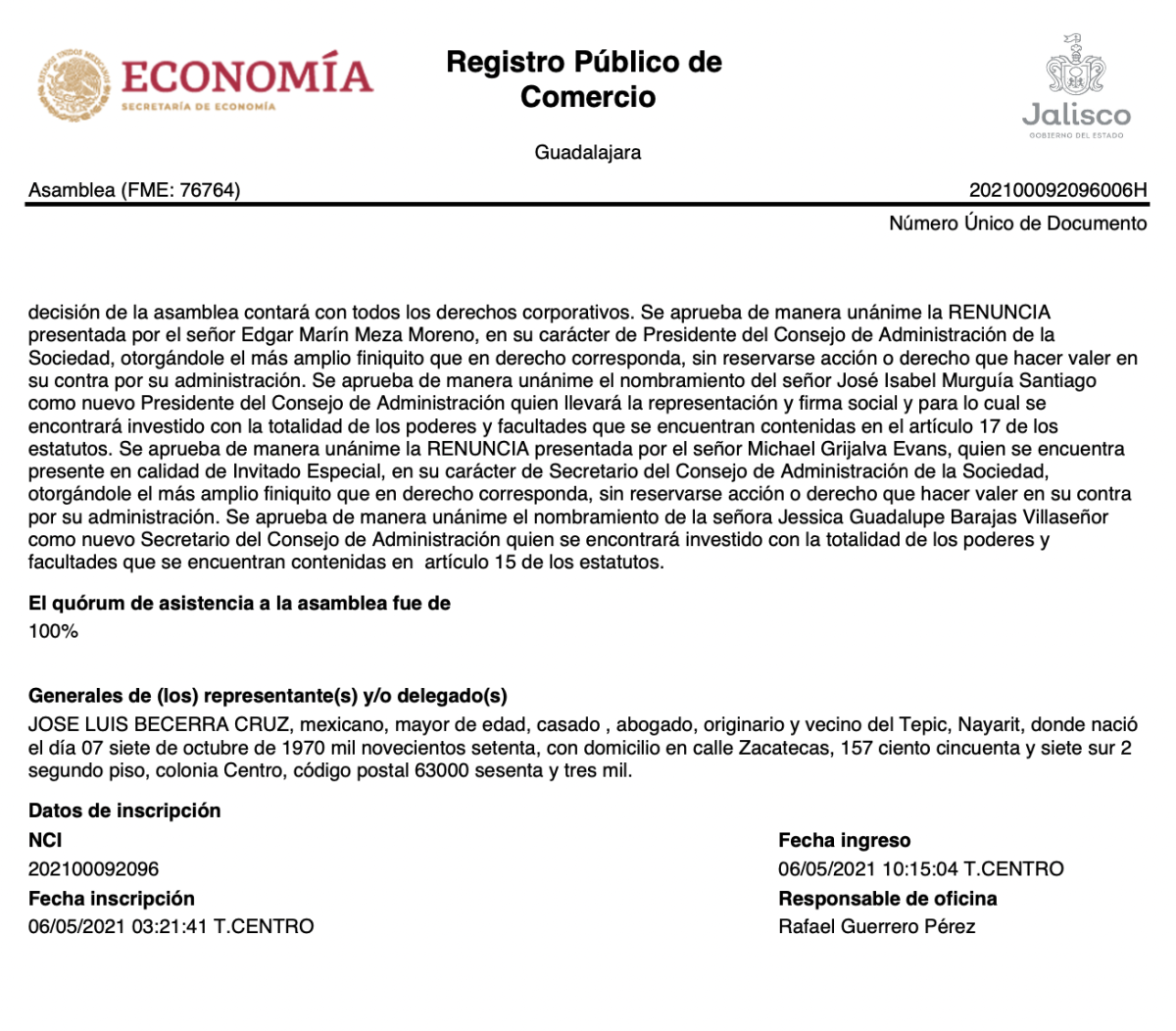
MCCI documented that the company IPS, in turn, is linked to Ecocarburante, a company that supplied fuel to Mexico’s Defense Ministry during construction of the Felipe Ángeles International Airport.
All of the companies mentioned above —Marlaya, Mefra Fletes, Dalcrise, IPS and Ecocarburante— appear in criminal case file 325/2025, opened by the FGR after the seizure of the Challenge Procyon tanker in mid-March 2025. That seizure revealed the existence of a broad fuel-smuggling network allegedly protected by military officials.

Marlaya’s fiscal damage
In the FGR’s case file on fuel-tax fraud, Marlaya is described as responsible for selling the fuel that entered Mexico illegally.
«Once the fuel is purchased in the United States, it is imported into Mexico to be sold to various companies, including Marlaya (…), which market petroleum products,» reads criminal case file 325/2025.
A document from Mexico’s Tax Administration Service, dated February 18, 2026, states that as a result of this hydrocarbon trade, the company incurred multimillion-peso tax evasion, estimated at a historical amount of 29,294,892,000 pesos.
The largest portion was determined by the Central Hydrocarbon Audit Administration (Administración Central de Fiscalización de Hidrocarburos): 29.1 billion pesos owed in undeclared income tax and value-added tax.
According to the document, the SAT had detected irregularities at Marlaya as early as September 2021. At that time, the company was fined for tax-law violations related to the commercialization of petroleum products in Mexico.
After a series of audit procedures, the SAT determined that Marlaya had been used for tax evasion or money laundering. In November 2025, the agency included the company in its definitive list of entities that invoice simulated transactions, known in Mexico as EFOS and colloquially as ‘factureras.’

The basis for the proceeding was that the company invoiced hydrocarbon sales despite lacking assets, infrastructure, operational capacity and personnel.
In November 2019, the company had requested authorization from the Energy Ministry to import up to 10 billion liters of diesel. The request was denied because Marlaya lacked supporting documentation, including supplier and customer information and permits from the Energy Regulatory Commission.
The company told both the SAT and the Energy Ministry that its tax domicile was a house on Tequila Street in the Vallarta Poniente neighborhood, behind Plaza Exhimoda in Guadalajara.

Another 3.8 billion pesos from a linked fuel-smuggling company
The same address used by Marlaya was also reported by Nafta Aditivos Orgánicos, another company investigated by the FGR for fuel smuggling and included by the SAT in September 2025 in its list of presumed fake-invoice companies.
That company obtained a permit in January 2017, during Enrique Peña Nieto’s administration, to import up to 252 million liters of gasoline. After the permit expired, it requested renewal under the López Obrador administration but later withdrew the application.
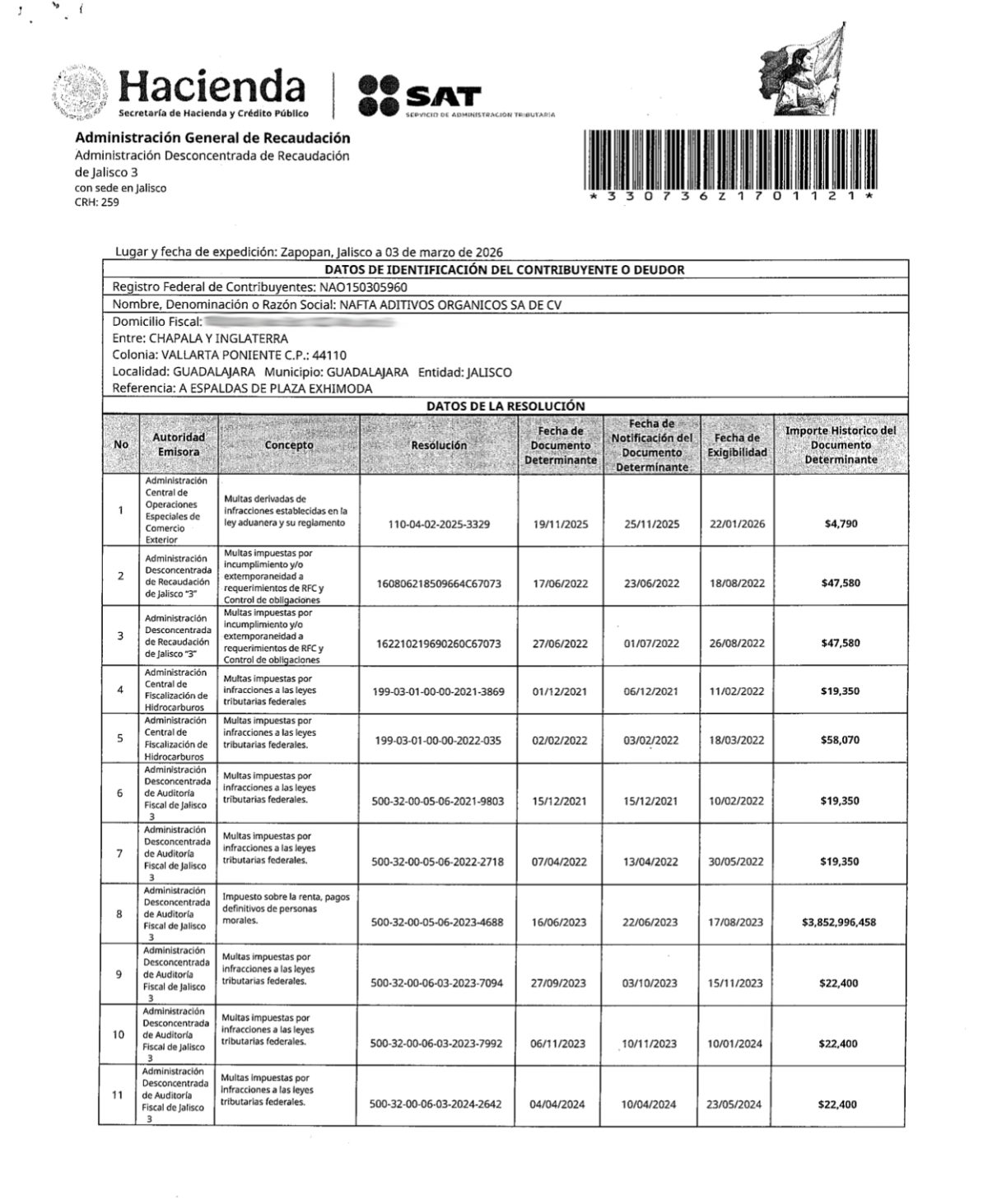
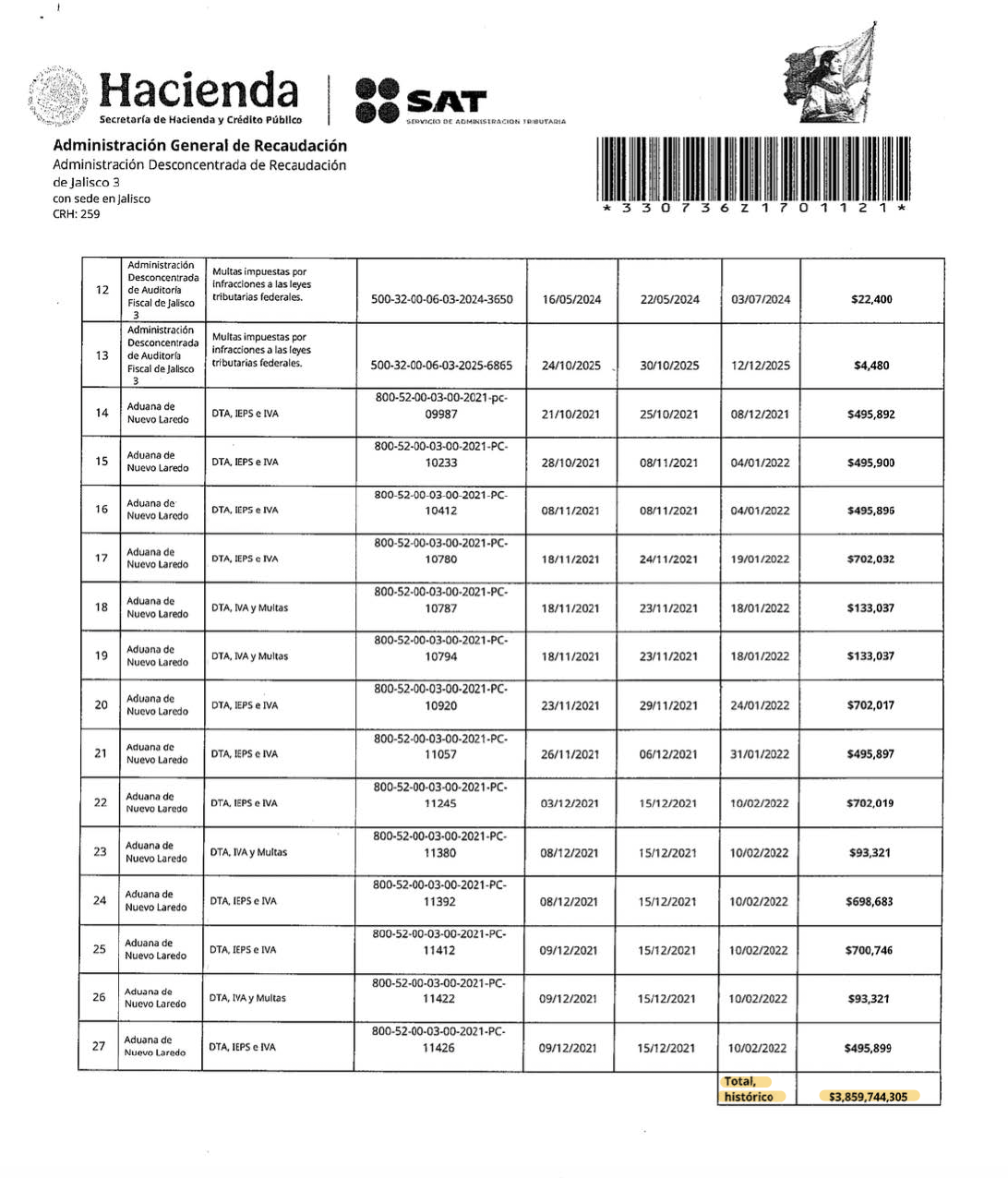
Customs records show that after its gasoline import permit expired, Nafta brought large volumes of oils and other petroleum derivatives into Mexico that are exempt from the Special Tax on Production and Services, known as IEPS.
An SAT notice dated March 3, 2026, determined that Nafta Aditivos Orgánicos had failed to pay 3.859 billion pesos in customs-processing fees, IEPS not declared at the Nuevo Laredo customs office, unpaid income tax and value-added tax, as well as fines stemming from violations of tax laws.
Tax Losses Exceeding the Budgets of Federal Ministries
The amount of taxes Marlaya evaded, as determined by Mexico’s Tax Administration Service (SAT), is equivalent to 33 times the budget of Mexico’s Anti-Corruption and Good Governance Ministry and 1.4 times the budget of the Federal Attorney General’s Office. These are two of the institutions responsible for investigating and sanctioning the public officials and private actors involved in the criminal fuel-tax fraud scheme.
Marlaya’s tax fraud also represents the cost of building nine Cablebús or Mexicable lines, flagship public-transit projects in the Mexico City metropolitan area. The average cost of each line was 3.35 billion pesos.
The amount defrauded would also be enough to build 500 national high school campuses like those recently inaugurated in Chimalhuacán and Ixtapaluca, each with capacity for 1,200 students; 862 National Guard barracks, at a unit cost of 34 million pesos; or 42 IMSS general hospitals with 100 to 200 beds, like those built in Ensenada, Baja California, and Ticul, Yucatan.
